
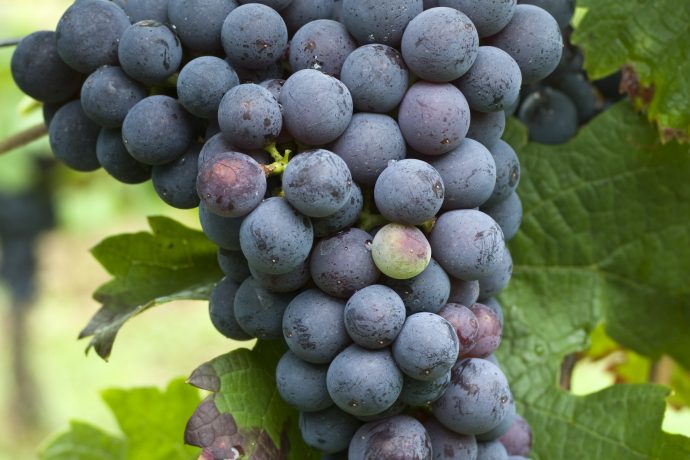
Cabernet Franc, a red wine grape originally from the Bordeaux region of France, has long been one of my favorite varietals. Its ruby-red appearance, intensely aromatic nose, medium body, bright fruit, and floral and herbal notes make it highly versatile as an aperitif or food wine. It’s often used as a blending wine, adding complexity and softness, but is also produced as a single varietal, manifesting as elegant, herbaceous, and peppery red wine. Cabernet Franc is now grown worldwide, most notably in California, Argentina, and Italy.
Cabernet Franc is renowned as one of the two cross-pollinated ancestors of Cabernet Sauvignon (as the name implies, it’s a cross of Cabernet Franc and Sauvignon Blanc). Despite Cab Franc being notably lighter, their genetic connection is more apparent when compared side-by-side. Cab Sauv tends to be significantly fuller-bodied and more tannic, with more dark fruit flavors; aging and bottling techniques can often produce wines that are much more similar. Cab Franc is frequently blended into the heavier Cabernets to soften the tannins and add cherry and herbal notes.
Friends and acquaintances often ask me to recommend the “best” Cabernet Franc (I tout how much I love the grape to anyone who will listen!). However, determining who makes the “best” Cabernet Franc is subjective, depending on personal taste and preference. I prefer heavier and fuller-bodied versions, especially those with notable herbal notes. However, here are a few of the more prominent producers worldwide:
France:
– Château Cheval Blanc (Bordeaux)
– Domaine de Chézaux (Loire Valley)
– Domaine Charles Joguet (Loire Valley)
United States:
– Mendel (California)
– Herman Story (California)
Canada:
– Norman Hardie (Ontario)
– Tawse Winery (Ontario)
Italy:
– Castello di Volpaia (Tuscany)
Argentina:
– Bodega Catena Zapata


0 Comments